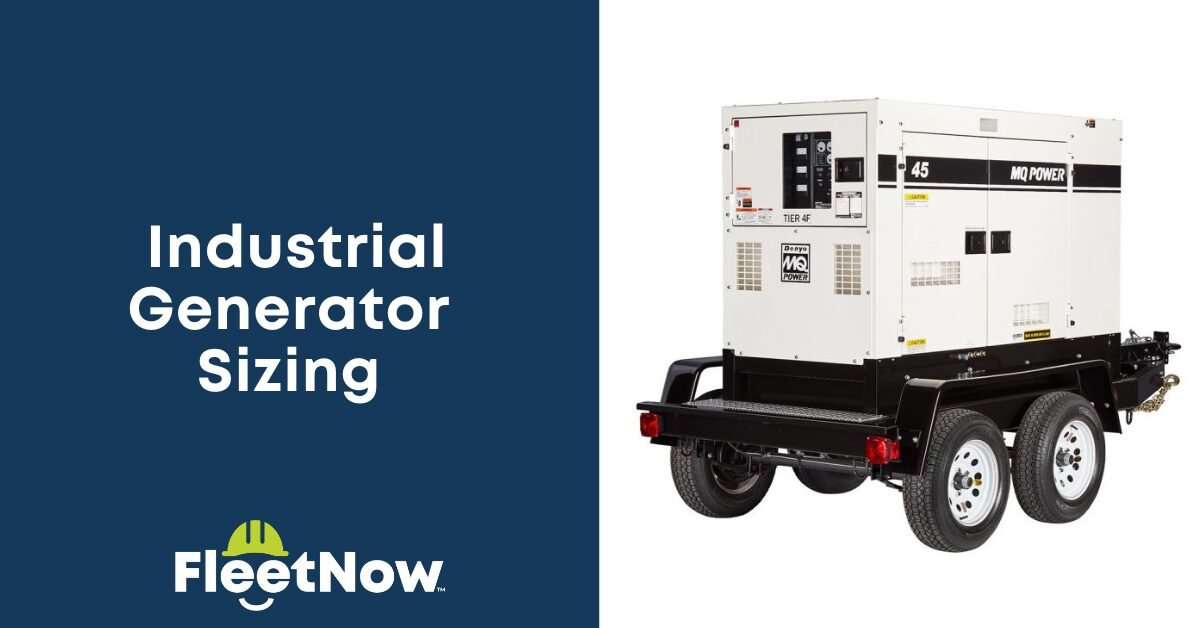
When the lights go out, or a new industrial project needs reliable power far off the grid, your business’s lifeline often hinges on a single, powerful machine: an industrial generator. Yet, the process of sizing, selection, and procurement of industrial generators isn't merely a purchase; it's a critical strategic decision that impacts everything from operational efficiency and project timelines to long-term costs and regulatory compliance. Get it wrong, and you could face anything from wasted fuel and premature equipment failure to crippling downtime and lost revenue. Get it right, and you ensure seamless operations, protect critical assets, and build resilience into your infrastructure.
This guide is for decision-makers who need to navigate the complexities of acquiring the right power solution. We'll cut through the jargon, offer practical advice, and ensure you walk away with the confidence to make the most informed choices.
At a Glance: Your Industrial Generator Checklist
- Calculate Total Power: Tally all running watts, then factor in higher starting (surge) watts for motors/compressors.
- Add a Safety Buffer: Always include 10-20% extra capacity for future needs or unexpected loads.
- Know Your Load Type: Resistive loads are simpler; inductive loads (motors) demand more robust surge capacity.
- Consult Experts: Leverage online calculators, certified electricians, and professional engineers.
- Consider Fuel: Evaluate diesel, natural gas, or propane based on availability, cost, and efficiency for your operation.
- ATS is Key: Ensure automatic transfer switch compatibility for seamless power restoration.
- Plan for Future Growth: Build in an additional 20-25% buffer for expansion.
- Understand Power Phases: Choose single-phase for smaller, simpler needs; three-phase for industrial machinery and high demands.
- Factor in Total Cost: Don't just look at purchase price; consider installation, fuel, and long-term maintenance.
Why Your Generator's Size Matters More Than You Think
Imagine buying a generator that's too small for your manufacturing plant. Critical machinery falters, production halts, and deadlines slip. Now imagine one that’s far too large. You’re overpaying upfront, burning excessive fuel, and dealing with inefficient operation that can lead to carbon buildup and a shorter lifespan for the generator itself. Neither scenario is desirable, which underscores why precise sizing is the bedrock of smart procurement.
Industrial generators aren't just for emergencies; they're integral to continuous operations, powering remote sites, maintaining climate control in critical facilities, or acting as prime power in areas without reliable grid access. Their capacity directly correlates with your operational continuity, energy efficiency, and overall budget.
The Crucial First Step: Determining Your Power Needs
Before you can select a generator, you need to understand exactly how much power your operations demand. This isn't a ballpark estimate; it requires meticulous calculation.
1. Total Power Consumption: Running vs. Starting Watts
Every piece of equipment, every light, every system in your facility consumes power. You need to account for two distinct types of wattage:
- Running Watts (Continuous Watts): This is the power an item uses once it's up and running smoothly. It's usually listed on the equipment's nameplate or manual.
- Starting Watts (Surge Watts): Many devices, especially those with electric motors (like pumps, compressors, HVAC units, or power tools), require a momentary burst of extra power to start up. This surge can be 2-3 times higher than their running wattage. Your generator must be capable of handling the highest simultaneous starting wattage demand.
How to Calculate:
Start by listing every device you intend to power. Note its running watts and, if applicable, its starting watts. Sum up all running watts. Then, identify the single item with the highest starting wattage and add its additional starting wattage (i.e., its starting watts minus its running watts) to your total running watts. This gives you a rough estimate of your maximum power demand. If multiple large inductive loads could start at the same time, your calculation becomes more complex and professional help is essential.
2. Don't Forget the Safety Margin
It's tempting to size a generator precisely to your current needs, but that’s a rookie mistake. Future changes, unexpected operational demands, or even just inaccuracies in your initial calculations can quickly leave you underpowered.
- Recommendation: Add a 10-20% safety margin to your total calculated wattage. This buffer accounts for potential growth, allows for minor load fluctuations, and prevents your generator from constantly running at its maximum capacity, which extends its lifespan.
3. Understanding Your Load Types: Resistive vs. Inductive
Not all watts are created equal. The type of load your generator will handle significantly influences its required capacity and performance.
- Resistive Loads: These are straightforward. Think of lights, heating elements, coffee makers – devices that convert electrical energy directly into heat or light. They have a consistent power draw and don't typically have high starting surges.
- Inductive Loads: These are the trickier ones. Motors, transformers, and anything with a magnetic field fall into this category. They require a significant surge of power upon startup to overcome inertia, which can be several times their continuous running wattage. Generators powering predominantly inductive loads need to be robust enough to handle these spikes without faltering.
4. Consult Manufacturer Specifications
Always cross-reference your calculations with the manufacturer's specified power parameters and usage suggestions for your key equipment. This ensures compatibility and prevents issues caused by mismatched power requirements. Don't assume; verify.
Diving Deeper into Power Requirements for Commercial & Industrial Settings
Once you have a handle on basic wattage, industrial and commercial applications require a more granular approach to truly establish total power requirements.
Steps for Calculating Total Power Needs
- Inventory All Electrical Equipment: Create a comprehensive list of every device, appliance, lighting fixture, HVAC system, and auxiliary technology. Gather detailed information on its wattage (or kilowatts), operational time, and peak consumption.
- Identify Continuous Loads: Pinpoint systems that run consistently for extended periods, such as HVAC, refrigeration units, server racks, or base lighting.
- Identify Peak Loads: Determine periods of short-term, high-demand. This often involves equipment startup sequences, heavy machinery cycles, or simultaneous operation of multiple high-draw devices. This is where inductive loads become critical.
- Apply Safety Margin: Reiterate adding a 10–20% buffer to your total calculated power for safety and future flexibility.
- Power Factor Correction: For facilities with significant inductive loads, the power factor can be less than 1.0, meaning the generator needs to supply more apparent power (kVA) than real power (kW). While generators are typically rated in kW, understanding your facility's power factor is crucial. Correcting a poor power factor, often with capacitors, improves efficiency and reduces the required generator size.
- Calculate Daily Needs (Watt-Hours): Multiply the wattage of continuous loads by their daily operational hours. For peak loads, factor in their duration and frequency. This gives you a watt-hour (Wh) or kilowatt-hour (kWh) total for daily consumption, which is useful for fuel consumption estimates.
- Cost Evaluation: While not strictly power needs, this step is vital for procurement. Compare the projected fuel/electricity costs per kWh or MMBtu (Million British Thermal Units) for different generator types and fuels. This is where the long-term operational cost truly emerges.
- Battery Sizing (for hybrid/backup systems): If incorporating battery storage for backup, ensure the battery bank's usable capacity (typically 80–90% of total capacity) can meet your specific needs.
- Backup Duration: Match your power needs to your battery size (if applicable) to determine how long critical systems can run during an extended outage without generator power.
- Installation Costs: Account for equipment purchase, delivery, crane services, electrical work, fuel line installation, and local permitting. These are significant components of the overall procurement cost.
Factoring in Facility Square Footage
As a general benchmark, facility square footage can offer a rough starting point for power estimates, though specific equipment lists are always more accurate.
- Office Buildings: Typically consume around 50-60 watts per square foot. A 10,000 sq ft office might need a 500-600 kW generator.
- Retail Stores: Often run between 60-80 watts per square foot. A 15,000 sq ft retail space could require 900-1,200 kW.
- Manufacturing Facilities: These are power hogs, consuming 80-100+ watts per square foot due to heavy machinery. A 20,000 sq ft plant might need 1,600-2,000 kW or more.
Remember to always incorporate peak demand, load diversity (not all systems run at once), and critical systems into these estimates. Energy-efficient building designs and equipment can significantly reduce your required generator size.
Voltage and Power Supply: Single-Phase vs. Three-Phase
One of the most fundamental distinctions in industrial power is the choice between single-phase and three-phase power. This isn't optional; it's dictated by your existing infrastructure and equipment.
| Feature | Single-Phase Power | Three-Phase Power |
|---|---|---|
| Voltage | Up to 230V (common for residential/light commercial) | Up to 415V (and higher in some industrial settings) |
| Wires Required | Two (Phase/Hot, Neutral) | Four (Three Phases/Hots, Neutral) |
| Consistency | Power delivery experiences peaks and dips | Provides steady, constant power due to overlapping phase cycles |
| Efficiency | Less efficient for high power applications | More efficient for large loads and motors |
| Load Capacity | Low (suitable for small appliances, basic lighting) | High (ideal for industrial machinery, data centers, large HVAC) |
| Applications | Homes, small offices, light commercial equipment | Factories, commercial buildings, data centers, large motors |
| Cost | Lower installation cost | Higher upfront installation, but saves in demanding industrial situations |
| Reliability | Interruption if the single phase fails | Other phases continue to supply power if one fails, improving uptime |
| Motor Torque | Often requires additional starter mechanisms | Provides sufficient torque directly, leading to simpler, more reliable motors |
| For most industrial applications, three-phase power is the standard due to its efficiency, reliability, and ability to handle heavy inductive loads. Evaluate your current and future energy needs with a professional to confirm the appropriate power phase. |
Planning for Future Expansion
The worst time to realize your generator is too small is when you’re trying to add new production lines or expand your facility.
- Strategy: Add an extra 20-25% buffer to your planned generator output. This foresight prevents costly upgrades or replacements down the line and ensures your power infrastructure can scale with your business.
Beyond Watts: Key Factors for Standby Generator Assessment
Once you have a clear picture of your power needs, several other critical factors influence the optimal selection of a standby generator.
Fuel Availability & Type
The choice of fuel significantly impacts operational costs, environmental footprint, and logistical considerations.
- Diesel: Known for its high energy density, efficiency, and long shelf life when stored properly. Diesel generators are robust and reliable, making them optimal for industrial uses where continuous, heavy-duty power is required. However, they require on-site fuel storage and emissions regulations can be a factor.
- Natural Gas: Often the most cost-effective option if your facility has direct access to a natural gas pipeline. It offers continuous fuel supply without the need for on-site storage (though emergency backup storage might still be considered). Emissions are generally cleaner than diesel.
- Propane (LPG): A good option where natural gas isn't available, but pipeline access isn't feasible. Propane can be stored on-site in tanks. It burns cleaner than diesel but is typically less energy-dense and can be more expensive than natural gas.
Assess local fuel options for dependability and economy. For instance, in areas prone to natural gas pipeline interruptions, a dual-fuel (natural gas/diesel) system might be a wise investment.
Automatic Transfer Switch (ATS) Integration
For a truly seamless backup power solution, an Automatic Transfer Switch (ATS) is non-negotiable.
- Function: An ATS constantly monitors the primary utility power supply. When it detects an outage, it automatically signals the generator to start, and then transfers the electrical load from the utility to the generator. When utility power is restored, it transfers the load back and signals the generator to shut down.
- Benefit: This fully automated process ensures minimal downtime, protects sensitive equipment from power fluctuations, and eliminates the need for manual intervention, which is crucial for critical facilities like data centers, hospitals, and manufacturing plants. Confirm that the generator you choose comes with or can easily connect to an appropriate ATS.
Safety Considerations and Code Compliance
Installing an industrial generator is a complex project with significant safety implications.
- Placement: Generators must be placed in well-ventilated areas, away from combustible materials, and with adequate clearance to buildings. Exhaust fumes (carbon monoxide) are lethal, requiring proper venting.
- Noise: Industrial generators can be loud. Consider local noise ordinances and the impact on neighboring properties or personnel, potentially requiring sound attenuation enclosures.
- Fuel Storage: On-site fuel tanks for diesel or propane must meet strict fire and environmental regulations.
- Electrical Codes: All wiring and connections must comply with local and national electrical codes (e.g., NEC in the US).
- Professional Installation: Always use certified electricians and contractors experienced in industrial generator installation to ensure all local codes and safety standards are met. This also includes proper grounding and wiring.
Servicing and Maintenance Intervals
Reliability isn't just about the generator's initial quality; it's about its ability to perform when needed.
- Consideration: Choose a generator designed for longer intervals between servicing and with readily available parts and service technicians. Regular maintenance schedules—including oil changes, filter replacements, and system checks—are paramount. Look for generators with robust diagnostic systems and remote monitoring capabilities that can alert you to potential issues before they become critical.
The Procurement Journey: Tools, Expertise, and Due Diligence
Making the final choice involves more than just crunching numbers; it's about leveraging the right resources and expert advice.
Sizing Calculators: Your Digital Assistant
Online tools from reputable manufacturers like Generac and Cummins can provide tailored generator size recommendations. You input your device wattages (running and starting) and peak demand, and the calculator suggests appropriate models.
- Caveat: While helpful for initial estimates, these calculators are often simplified. Always verify their trustworthiness and use them as a starting point, not a definitive answer. Your specific operational context will almost certainly require human expertise.
The Certified Electrician: Your On-Site Expert
A certified electrician is invaluable for hands-on assessment.
- Role: They provide expert insight into your facility's existing electrical infrastructure, assess actual power needs based on a detailed on-site survey, and ensure the proposed installation will comply with all local electrical codes. They're critical for identifying potential bottlenecks or necessary upgrades to your wiring.
The Professional Engineer: The Master Strategist
For critical facilities (e.g., data centers, healthcare, large manufacturing), a Professional Engineer (PE) is essential.
- Role: A PE can cross-check load profiles against generator capacity, perform complex calculations, verify safety standards, and ensure regulatory compliance. They can also design comprehensive power solutions that integrate multiple generators, renewable energy sources, and sophisticated control systems. Their involvement is a safeguard against oversight and a guarantee of a robust, compliant solution.
Beyond Purchase Price: Cost Evaluation
The true cost of a generator extends far beyond its sticker price. This is where the Levelized Cost of Energy (LCOE) comes into play, especially for prime power applications or hybrid systems.
- LCOE Calculation: This considers not just the initial capital expenditure, but also ongoing fuel costs, maintenance, operational expenses, and even decommissioning costs over the generator's entire lifespan. Comparing LCOE between different generator types (e.g., diesel vs. natural gas) and potential hybrid solutions (e.g., solar-generator-battery) offers a much more accurate financial picture. M. Das et al.'s research, for instance, highlights how an initial sizing approach for solar PV, biogas, and battery storage hybrid systems can significantly reduce LCOE for remote area electrification, improving both energy cost and dependability.
Installation Costs: The Hidden Expense
Factor in all installation-related expenses:
- Equipment Delivery: Often requires specialized transport and crane services.
- Site Preparation: Foundation work, grading, and potentially sound-proofing enclosures.
- Electrical Wiring: Connecting the generator to your transfer switch and main electrical panel.
- Fuel System: Installing fuel tanks, lines, and pumps (for diesel/propane) or connecting to the natural gas supply.
- Exhaust System: Proper venting and, if needed, emissions control.
- Permitting & Inspections: Navigating local regulations.
These costs can sometimes rival the generator's purchase price, so budget accordingly.
Industrial vs. Commercial vs. Portable: Knowing the Difference
While all generate power, their capabilities and intended uses vary dramatically.
- Industrial Generators: These are the titans of power. Built for heavy workloads, continuous operation, and demanding environments, they are typically large, permanently installed, and designed for long operational hours and rigorous demands of factories, data centers, oil & gas operations, and large infrastructure projects. They prioritize durability, efficiency, and high capacity. Learn more about industrial generators and their specific applications.
- Commercial Generators: Designed to power activities for office buildings, retail shops, smaller manufacturing facilities, and other businesses. They offer substantial power output but are generally not built for the same level of continuous, heavy-duty prime power as their industrial counterparts. They often focus on standby applications during grid outages.
- Portable Generators: These are the smallest and least powerful, suitable only for temporary or emergency power needs at construction sites, small events, or residential backup. Their low capacity and limited runtime make them entirely unsuitable for sustained industrial or large commercial operations. High and continuous power needs always require permanently installed industrial or commercial-grade generators.
Insights from the Field: Modern Generator Considerations
The landscape of industrial power generation is constantly evolving, influenced by advancements in technology and growing demands for efficiency and resilience.
Research by Baran Gulkaya et al. on microgrid frequency regulation highlights the increasing integration of emergency generators within microgrids, often alongside renewable energy sources like solar and even Vehicle-to-Grid (V2G) systems. This suggests a future where industrial generators are not just isolated backup units but integral components of dynamic, smart grids that prioritize stability and efficient energy management. Optimal sizing in these complex systems becomes even more crucial for maintaining frequency stability and overall system health.
Furthermore, K. Timalsena et al.'s examination of need-based reliability investment in industrial power distribution underscores the critical importance of not just sizing, but also the broader infrastructure supporting your generator. Factors like fuel reserve redundancy and the precise timing of fuel-economy gears' cut-in can profoundly impact a system's reliability and downtime. Investing in robust reliability measures significantly enhances performance and protects against costly interruptions. This moves beyond simply "having a generator" to "having a generator system that always works."
Making Your Final Decision: A Checklist for Success
You've done the homework, consulted the experts, and considered all the variables. Here’s a concise checklist to guide your final procurement decision:
- Validated Power Needs: Are your total running watts, peak starting watts, and future expansion needs thoroughly calculated and verified by a professional?
- Appropriate Fuel Source: Have you chosen the most economical, reliable, and sustainable fuel type for your location and operational profile?
- Phase Matching: Is the generator compatible with your facility's single-phase or three-phase power requirements?
- ATS Compatibility: Does the generator integrate seamlessly with an automatic transfer switch for hands-off operation?
- Site Suitability: Have you accounted for installation space, ventilation, noise, emissions, and local permitting requirements?
- Reliability & Serviceability: Does the manufacturer have a proven track record? Are parts and qualified service technicians readily available in your region?
- Total Cost of Ownership: Have you factored in not just the purchase price, but also installation, fuel, maintenance, and potential LCOE benefits of alternative solutions?
- Scalability: Does the chosen system allow for future expansion, or will it become a bottleneck?
- Regulatory Compliance: Have all local, state, and national safety and environmental regulations been addressed?
Choosing the right industrial generator is a significant investment that pays dividends in operational resilience and peace of mind. By systematically addressing each of these critical areas—from detailed sizing to strategic procurement—you'll ensure your industrial generator isn't just a purchase, but a cornerstone of your ongoing success.